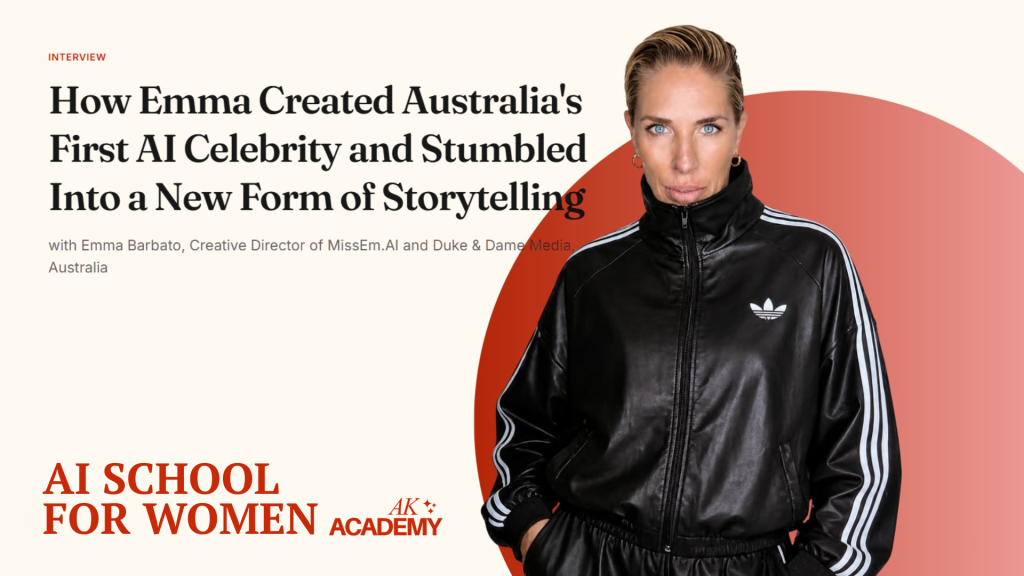
Emma Barbato of MissEm.AI has been featured in an in-depth interview with AK Academy, The Global AI School for Women, discussing her work with hyper-fiction, Bruce Ryder, and the new era of interactive entertainment.
For Emma, opportunities like this matter because they let her draw a line most of the industry still hasn’t drawn. What she’s building with Bruce Ryder isn’t an AI influencer replicating human content to fool an audience, it’s hyper-fiction: layered, ongoing world-building where the audience is invited in to co-create, rather than sold a synthetic imitation of a person. It’s a distinction she believes matters more than most of the industry is currently willing to admit.
The interview traces the origin story many people don’t know: Bruce Ryder wasn’t conceived as an entertainment project at all. He began as a branding solution for Emma’s men’s body care label, Ducks Nuts Balls, when her husband the original face of the brand, could no longer keep up with the content demands of running the e-commerce business. Watching international AI ambassadors emerge at the time, Emma realised she didn’t need to cast a replacement. She could create one, with no traditional production limits and an ambitious creative brief that could expand the brand’s universe rather than just represent it.
Bruce outgrew the brand within about a year. What started as body care became the weekly Bruce Ryder Show, now on all major streaming platforms, and the project that pulled Emma fully into questions of AI, entertainment, and the future of storytelling. Bruce has since been referenced in academic papers and folded into the curriculum at the Australian Film and Radio School, an unusual trajectory for a character born out of a branding fix.
The interview also gets into how Emma actually built the skillset behind it all, with no technical background whatsoever. Her case is that AI isn’t a craft in itself, it’s an amplifier of the craft someone has already spent years building. The skills that mattered for her weren’t prompting, but imagination, curiosity, and a willingness to disregard the rules. She learned entirely by doing, and describes writing every script, directing every piece of content, and producing the weekly show herself, while running her other consulting and speaking work alongside it.
One thread that runs through the piece is Emma’s belief that this is a genuinely rare moment for women entering the space: not climbing a ladder that already exists, but building it collectively, alongside everyone else arriving early. She’s clear that this isn’t about women being uniquely suited to AI, it’s that nobody currently has seniority in a field this new. The people who define what comes next won’t necessarily be the most technical; they’ll be the ones willing to get in early and commit to it.
The interview closes on where she sees the hyper-fiction economy heading, collaborations, merchandise, and increasingly, the microtransaction models already proven out by platforms like Roblox and Fortnite and previews hyp-fiction.com, her upcoming publication dedicated to curating and reporting on the genre as it grows.
If this story reaches even one woman at the very beginning of exploring this medium, her hope is simple, don’t let your creativity be flattened into what social media validates as storytelling. Build the world only you can see. Build fantasy worlds we don’t have yet. Tell the stories we haven’t heard, and push this medium into uncharted waters we’ve never explored.
Read the full interview at AK Academy: How Emma Created Australia’s First AI Celebrity and Stumbled Into a New Form of Storytelling.