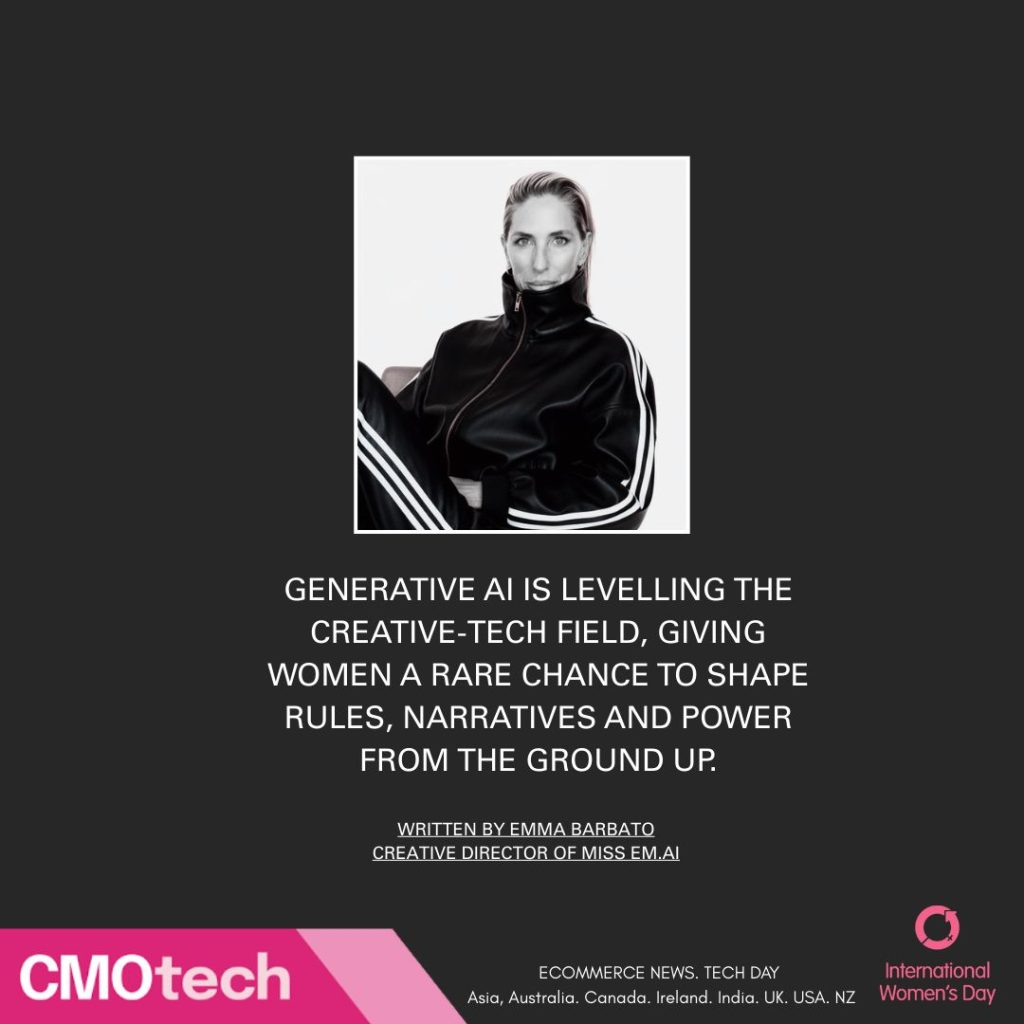
Emma Barbato was invited to contribute to TechDay Australia’s global International Women’s Day 2026 publication, under this year’s theme, #BalanceTheScales.
It’s not a topic Emma normally dwells on, nor one she’s allowed to create mental barriers in her own career. But the invitation felt like a rare opportunity to spotlight a genuinely pivotal moment across tech and the creative industries, entertainment especially. Her piece, titled “We are not climbing a ladder, we are building it,” argues that IWD conversations traditionally focus on barriers to entry for women in tech. Right now, though, both men and women are standing at the base of a ladder that’s still being built, on equal footing. The only real differentiator left is talent, love of the craft, relentless learning, and the courage to actually use decades of honed skill.
In the piece, Emma acknowledges the real structural barriers women have historically faced in tech gatekeeping networks, authority bias that equated legitimacy with a narrow definition of engineering, venture capital patterns that kept funding cycling through the same circles, and a confidence gap built from being told, for years, that women were adjacent to technology rather than central to it. Generative AI, she argues, has disrupted much of that. Tool access is democratised, there’s no twenty-year seniority ladder gatekeeping who’s “allowed” to build, and the skills that now carry real technical leverage are the ones creatives have always had: cultural intelligence, narrative storytelling, and brand thinking.
Where traditional entertainment has entrenched distribution pipelines, commissioning models and IP frameworks, generative AI’s equivalent structures are still being drafted in real time. Emma describes that as the entire point: the blueprint is still wet. In her own work, that openness is what let her build Bruce Ryder, Australia’s first AI celebrity and winner of Best AI Influencer of 2025 at the Australian AI Festival, not as a novelty character, but as a genuine experiment in what creative freedom looks like without gatekeepers standing between an idea and its audience. Rather than building another polished, quick-consumption character for social media, she used Bruce to explore hyper-media: breaking the fifth wall so an audience could move from passive viewer to active participant, with intellectual property, commercial partnerships and audience co-authorship built in from the start.
Being featured among a small cohort of women in the inaugural AI edition of Lürzer’s Archive reinforced something Emma sees as the real story here, AI-driven storytelling has moved from fringe experimentation into the global creative canon. The open question isn’t how many women can operate in the space. It’s who’s willing to take the seats still being built, while they’re still available to whoever shows up ready to build.
As Emma writes: generative AI remains malleable in a way legacy industries no longer are. Women entering now aren’t arriving late to a finished table they’re sitting down while the table is still under construction. The industry doesn’t yet have a gate. And in that uncertainty, there’s real equality.
Read the full piece on TechDay Australia / eCommerceNews Australia: “We are not climbing a ladder, we are building it.”