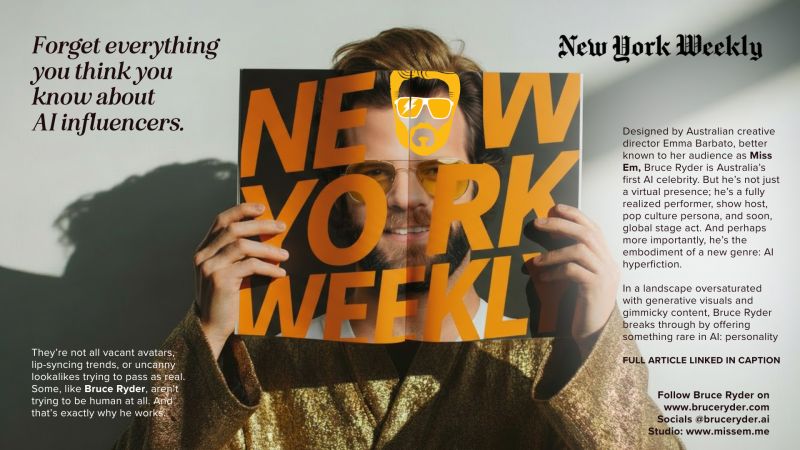
New York Weekly has featured Bruce Ryder and his creator, Miss Em, in a piece titled “Welcome to the Age of AI Hyperfiction: Bruce Ryder Is the Digital Icon Built for Now” a feature that positions Bruce as proof of an entirely new genre, rather than another entry in the AI influencer category.
The piece opens by dismissing the assumption that AI influencers are interchangeable, vacant avatars chasing trends or uncanny lookalikes trying to pass as real. Bruce, it argues, works precisely because he isn’t trying to be human at all. He’s framed as Australia’s first AI celebrity, but also as a fully realised performer, show host and pop culture persona: the embodiment of AI hyperfiction, a genre the article describes as blending storytelling, social engagement, gaming and character development into one reactive ecosystem where the audience shapes the story rather than simply consuming it.
New York Weekly traces Bruce’s show format , part retro radio comedy, part real-time choose-your-own-adventure across Instagram, YouTube and Facebook, with fans able to influence the direction of upcoming episodes. The article credits his self-awareness and humour as the difference-maker, framing him as a reflection of collaboration between technology and human creativity, rather than a product of automation. As Emma told the publication, Bruce was never built to replicate people he was purpose-built to entertain as an AI, a new character for a new kind of audience.
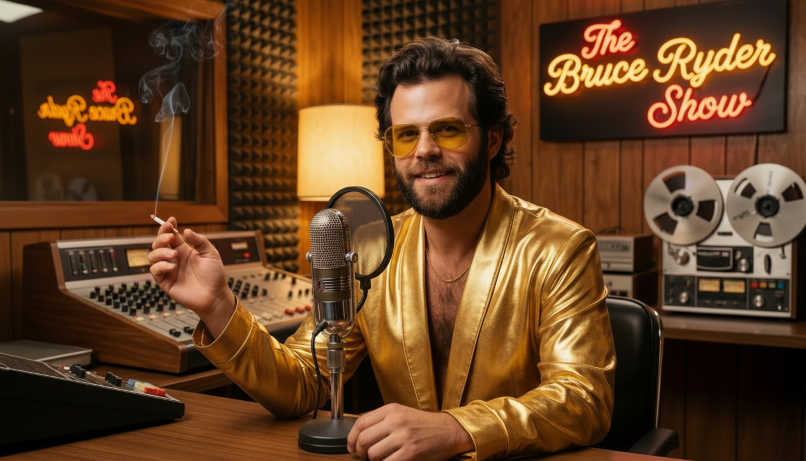
The feature also runs through the milestones that built the case for Bruce as a cultural first: developed over ten months of hand-sketching and two years of iterative storytelling, his co-presenting appearance alongside Emma at Retail Global, his casting in the Belgian AI film Genesis.0, his Best AI Influencer win at the 2025 Australian AI Festival, and his run as a short film finalist at the Disrupt AI Film Festival alongside his body care line and merchandise.
What the piece keeps returning to is personality over polish. Bruce isn’t chasing photorealism, he’s cheeky, irreverent, proudly Australian, part late-night host and part animated larrikin, and audiences follow him for his voice rather than his visual fidelity. As the article puts it, in an industry where most AI creators try to look real, Bruce tries to feel real and that distinction is the whole point. It’s consistent with how Emma has always framed him: here to entertain, not replace, and built as a transparent, engaging, human-facing new frontier of media, not a substitute for it.
Read the full feature on New York Weekly: “Welcome to the Age of AI Hyperfiction: Bruce Ryder Is the Digital Icon Built for Now.”