
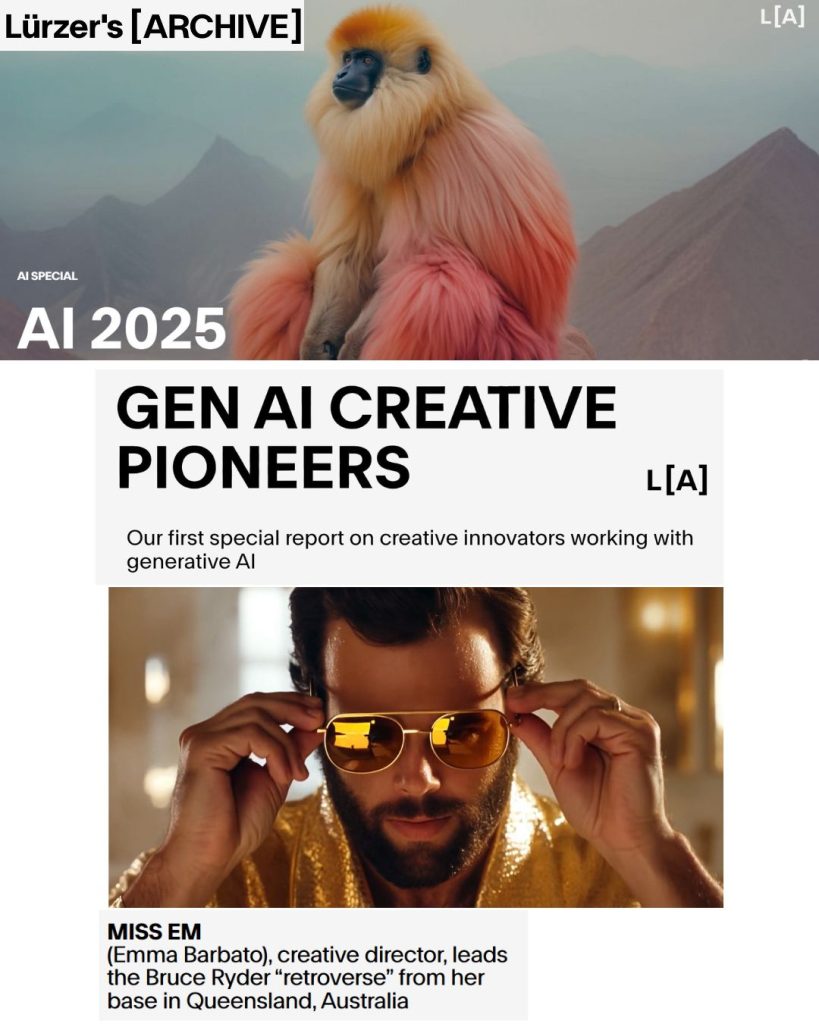
For over four decades, Lürzer’s Archive has been the reference point advertising and creative industries turn to the publication that has quietly defined who counts as a serious creative voice, issue after issue. So when Emma Barbato learned she’d be featured in the magazine’s first-ever special report dedicated to generative AI, it registered as something closer to disbelief than excitement. Being included in that lineup, she says, still feels hard to fully process and she’s genuinely waiting on the physical copy to arrive, if only to prove to herself it’s real.
The report, titled AI 2025, was built the old-fashioned way: the editors asked a handful of creative people making a name for themselves who they looked to as peers and reference points, then followed that thread outward until clear patterns emerged. The resulting lineup places Emma alongside names like PJ Accetturo, Roxanne Ducharme, Adam Ferrier, Matt Zien, Martin Pagh Ludvigsen, Drew Brucker, Peter Gasston, Lars Bastholm, Kent Boswell, Marcus Tesoriero and The Dor Brothers, creative directors, AI filmmakers and innovation leads from agencies including Ogilvy, GS&P and VCCP, credited with shaping what generative AI actually looks like when it’s handled with intent. Emma credits Paul Foster for the invitation to contribute.
For Lürzer’s Archive to formally step into the AI conversation across film, photography and commercial creative work signals, in Emma’s words, just how far the medium has come from something dismissed as a passing novelty.
Emma’s contribution to the report makes a point of separating her work from much of what else is being celebrated in the issue. Bruce Ryder’s impact was never about advanced visual graphics or hyper-realistic rendering. Her section instead frames him as Australia’s first AI celebrity, and the first to debut live on a major stage alongside a human, at the Gold Coast Convention Centre in May 2025, a character who has since set up brand deals and sold his own merchandise range. But the substance, she writes, was never in the surface-level tech. It sits in more than a year of focused AI development layered onto over fifteen years of expertise in brand building, narrative design and behavioral science.
Bruce, as Emma describes him in the piece, is the outcome of a long-form, strategic creative process concerned with how people connect, relate to, and emotionally invest in a story not machine-led output, but human-led intent informed by how audiences actually think and feel. That’s what she credits for his particular “golden wild card of nostalgia” pull. Through Bruce, she and her team are pioneering hyperfiction: a genre where the fifth wall breaks down entirely, and the viewer becomes a living participant rather than a spectator. The relational complexity of that how audiences see themselves in Bruce, participate in his world, and help tell the story alongside the team is, in her framing, the real innovation.
The piece also gets specific about how success is actually measured in that world. Rather than reach alone, Emma describes watching audience engagement in real time: whether people stay inside the story, return for further arcs, and step in to interact rather than simply consume. The high watermark for hyperfiction, as she puts it, is the story becoming genuinely irresistible to engage with treated, right now, as a live experiment in measuring allure alongside reach, at the threshold of a storytelling era where the audience itself will set the pace of how ready they are to become the player, not just the viewer.
Being placed in that report, printed on the shelf next to four decades of the industry’s most influential creative work, is the kind of validation that doesn’t come along often — and for Emma, it’s proof that hyperfiction has moved well past the fringe.
Read the full feature on Lürzer’s Archive: AI 2025.